
MPPSC Assistant Professor English Literature
Figures of Speech and Literary Terms – 50 MCQs with Answers
1. A figure of speech in which a comparison is made using "like" or "as" is called:
A) Metaphor
B) Simile
C) Hyperbole
D) Irony
Answer: B) Simile
Explanation: A simile directly compares two unlike things using words such as "like" or "as." Example: "Her face is like a rose."
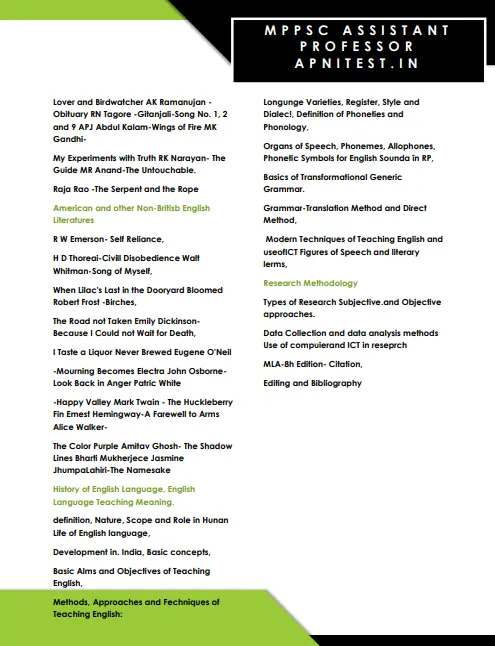
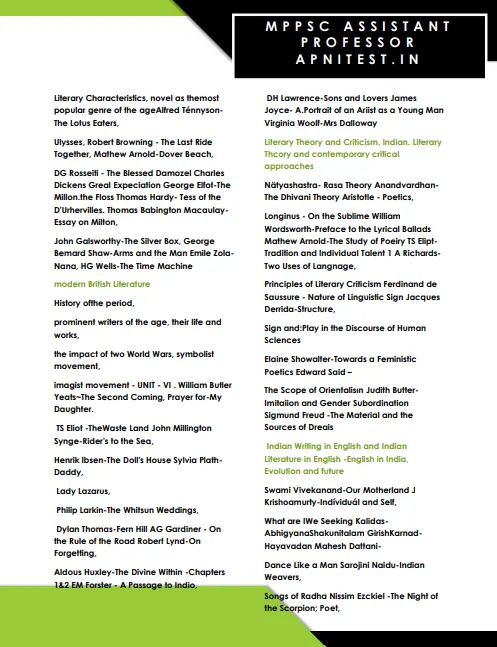
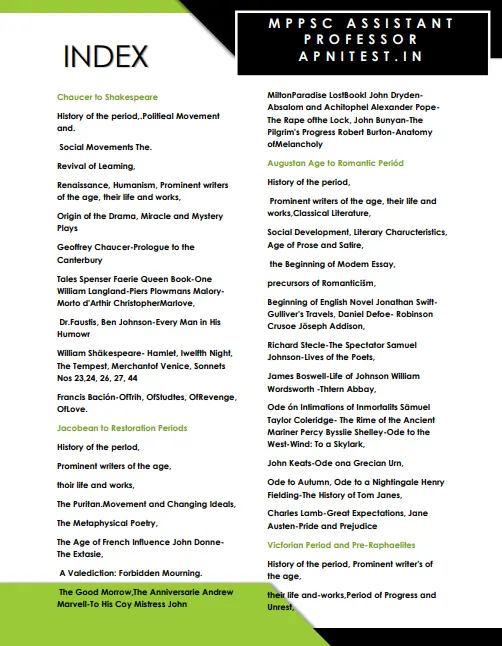
MPPSC ASSISTANT PROFESSOR ENGLISH LITERATURE BOOK AND TEST SERIES BUY LINK -https://www.apnitest.in/shop/mppsc-assistant-professor-english-book-and-test-series-371?search=mppsc
2. "Time is a thief" is an example of:
A) Simile
B) Personification
C) Metaphor
D) Oxymoron
Answer: C) Metaphor
Explanation: A metaphor makes an implied comparison without using "like" or "as."
3. Giving human qualities to non-human objects is called:
A) Hyperbole
B) Personification
C) Metonymy
D) Synecdoche
Answer: B) Personification
Explanation: Personification attributes human characteristics to animals, objects, or ideas
MPPSC ASSISTANT PROFESSOR ENGLISH LITERATURE BOOK AND TEST SERIES BUY LINK -https://www.apnitest.in/shop/mppsc-assistant-professor-english-book-and-test-series-371?search=mppsc
4. Deliberate exaggeration for emphasis is:
A) Litotes
B) Irony
C) Hyperbole
D) Euphemism
Answer: C) Hyperbole
Explanation: Hyperbole is an overstatement used to create a strong impression.
5. "Sweet sorrow" is an example of:
A) Oxymoron
B) Metaphor
C) Allusion
D) Simile
Answer: A) Oxymoron
Explanation: An oxymoron combines contradictory terms.
6. Repetition of initial consonant sounds is:
A) Assonance
B) Alliteration
C) Consonance
D) Onomatopoeia
Answer: B) Alliteration
Explanation: Example: "She sells sea shells."
MPPSC ASSISTANT PROFESSOR ENGLISH LITERATURE BOOK AND TEST SERIES BUY LINK -https://www.apnitest.in/shop/mppsc-assistant-professor-english-book-and-test-series-371?search=mppsc
7. Repetition of vowel sounds is:
A) Assonance
B) Alliteration
C) Metonymy
D) Irony
Answer: A) Assonance
Explanation: Example: "The rain in Spain stays mainly in the plain."
8. Words that imitate natural sounds are:
A) Synecdoche
B) Irony
C) Onomatopoeia
D) Euphemism
Answer: C) Onomatopoeia
Explanation: Examples include buzz, hiss, bang, and roar.
9. "The pen is mightier than the sword" contains:
A) Metonymy
B) Hyperbole
C) Simile
D) Apostrophe
Answer: A) Metonymy
Explanation: "Pen" stands for writing and "sword" for military power.
10. A part representing the whole is:
A) Metonymy
B) Synecdoche
C) Irony
D) Litotes
Answer: B) Synecdoche
Explanation: Example: "All hands on deck."
MPPSC ASSISTANT PROFESSOR ENGLISH LITERATURE BOOK AND TEST SERIES BUY LINK -https://www.apnitest.in/shop/mppsc-assistant-professor-english-book-and-test-series-371?search=mppsc
11. An indirect reference to a famous person or event is:
A) Allusion
B) Allegory
C) Symbol
D) Pun
Answer: A) Allusion
Explanation: Example: Referring to someone as "Einstein."
12. A narrative with a hidden moral meaning is:
A) Satire
B) Allegory
C) Ballad
D) Elegy
Answer: B) Allegory
Explanation: An allegory has both literal and symbolic meanings.
13. A word having multiple meanings used humorously is:
A) Pun
B) Irony
C) Symbolism
D) Euphemism
Answer: A) Pun
Explanation: Puns create humor through wordplay.
14. Saying less than what is meant is:
A) Hyperbole
B) Litotes
C) Metaphor
D) Simile
Answer: B) Litotes
Explanation: Example: "Not bad" meaning very good.
15. A mild expression replacing a harsh one is:
A) Irony
B) Euphemism
C) Hyperbole
D) Satire
Answer: B) Euphemism
Explanation: Example: "Passed away" instead of "died."
MPPSC ASSISTANT PROFESSOR ENGLISH LITERATURE BOOK AND TEST SERIES BUY LINK -https://www.apnitest.in/shop/mppsc-assistant-professor-english-book-and-test-series-371?search=mppsc
16. Addressing an absent person or abstract idea is:
A) Apostrophe
B) Allegory
C) Symbolism
D) Metonymy
Answer: A) Apostrophe
Explanation: Example: "O Death, where is thy sting?"
17. Verbal irony occurs when:
A) Words mean exactly what they say
B) Words mean the opposite of what is said
C) Events are expected
D) Characters know everything
Answer: B) Words mean the opposite of what is said
Explanation: Example: Saying "What lovely weather!" during a storm.
18. Dramatic irony means:
A) Reader knows less than characters
B) Reader knows more than characters
C) No irony exists
D) Writer is absent
Answer: B) Reader knows more than characters
Explanation: Commonly used in drama.
19. A symbol is:
A) Direct statement
B) Object representing a larger idea
C) Exaggeration
D) Pun
Answer: B) Object representing a larger idea
Explanation: A dove symbolizes peace.
MPPSC ASSISTANT PROFESSOR ENGLISH LITERATURE BOOK AND TEST SERIES BUY LINK -https://www.apnitest.in/shop/mppsc-assistant-professor-english-book-and-test-series-371?search=mppsc
20. Satire aims to:
A) Praise society
B) Criticize through humor and ridicule
C) Narrate history
D) Describe nature
Answer: B) Criticize through humor and ridicule
Explanation: Satire exposes human follies.
21. A long narrative poem about heroic deeds is:
A) Ode
B) Epic
C) Elegy
D) Sonnet
Answer: B) Epic
Explanation: Examples include the Iliad and Paradise Lost.
22. A poem mourning the dead is:
A) Ballad
B) Elegy
C) Ode
D) Lyric
Answer: B) Elegy
Explanation: Example: Gray's Elegy Written in a Country Churchyard.
23. A lyric poem expressing praise is:
A) Ode
B) Epic
C) Satire
D) Ballad
Answer: A) Ode
Explanation: Odes celebrate a person, thing, or event.
24. A narrative song is:
A) Sonnet
B) Ballad
C) Ode
D) Epic
Answer: B) Ballad
Explanation: Ballads tell stories in song form.
MPPSC ASSISTANT PROFESSOR ENGLISH LITERATURE BOOK AND TEST SERIES BUY LINK -https://www.apnitest.in/shop/mppsc-assistant-professor-english-book-and-test-series-371?search=mppsc
25. A fourteen-line poem is:
A) Ballad
B) Sonnet
C) Epic
D) Elegy
Answer: B) Sonnet
Explanation: Shakespearean and Petrarchan are famous sonnet forms.
26. The central idea of a literary work is:
A) Plot
B) Theme
C) Character
D) Setting
Answer: B) Theme
Explanation: Theme is the underlying message.
27. The sequence of events in a story is:
A) Theme
B) Plot
C) Tone
D) Style
Answer: B) Plot
Explanation: Plot structures the narrative.
28. The attitude of the writer toward the subject is:
A) Tone
B) Theme
C) Symbol
D) Allegory
Answer: A) Tone
Explanation: Tone may be serious, humorous, ironic, etc.
29. The place and time of a story are called:
A) Theme
B) Setting
C) Tone
D) Motif
Answer: B) Setting
Explanation: Setting provides background.
MPPSC ASSISTANT PROFESSOR ENGLISH LITERATURE BOOK AND TEST SERIES BUY LINK -https://www.apnitest.in/shop/mppsc-assistant-professor-english-book-and-test-series-371?search=mppsc
30. A recurring image or idea is:
A) Motif
B) Theme
C) Plot
D) Style
Answer: A) Motif
Explanation: Motifs reinforce themes.
31. The protagonist is:
A) Villain
B) Main character
C) Narrator
D) Minor character
Answer: B) Main character
Explanation: The protagonist drives the action.
32. The antagonist is:
A) Friend of hero
B) Main opponent
C) Narrator
D) Author
Answer: B) Main opponent
Explanation: The antagonist creates conflict.
33. Conflict means:
A) Agreement
B) Struggle between opposing forces
C) Description
D) Symbolism
Answer: B) Struggle between opposing forces
Explanation: Conflict is essential to plot.
MPPSC ASSISTANT PROFESSOR ENGLISH LITERATURE BOOK AND TEST SERIES BUY LINK -https://www.apnitest.in/shop/mppsc-assistant-professor-english-book-and-test-series-371?search=mppsc
34. The climax is:
A) Beginning
B) Highest point of action
C) End
D) Setting
Answer: B) Highest point of action
Explanation: It is the turning point of the story.
35. Resolution refers to:
A) Conflict introduction
B) Conclusion of events
C) Character sketch
D) Dialogue
Answer: B) Conclusion of events
Explanation: It resolves the conflict.
36. A narrator using "I" is:
A) Third-person narrator
B) Omniscient narrator
C) First-person narrator
D) Objective narrator
Answer: C) First-person narrator
Explanation: The story is told from the narrator's perspective.
37. Foreshadowing is:
A) Flashback
B) Hint of future events
C) Dialogue
D) Symbol
Answer: B) Hint of future events
Explanation: It creates suspense.
MPPSC ASSISTANT PROFESSOR ENGLISH LITERATURE BOOK AND TEST SERIES BUY LINK -https://www.apnitest.in/shop/mppsc-assistant-professor-english-book-and-test-series-371?search=mppsc
38. A flashback is:
A) Future prediction
B) Shift to earlier events
C) Narration style
D) Climax
Answer: B) Shift to earlier events
Explanation: Flashbacks provide background information.
39. Imagery appeals primarily to:
A) Logic
B) Senses
C) Grammar
D) Structure
Answer: B) Senses
Explanation: Imagery creates vivid sensory experiences.
40. The study of versification is:
A) Prosody
B) Semantics
C) Morphology
D) Syntax
Answer: A) Prosody
Explanation: Prosody deals with meter and rhythm.
MPPSC ASSISTANT PROFESSOR ENGLISH LITERATURE BOOK AND TEST SERIES BUY LINK -https://www.apnitest.in/shop/mppsc-assistant-professor-english-book-and-test-series-371?search=mppsc
41. Iambic pentameter consists of:
A) Five iambs per line
B) Four iambs
C) Six iambs
D) Three iambs
Answer: A) Five iambs per line
Explanation: Common in Shakespeare's plays.
42. Blank verse is:
A) Unrhymed iambic pentameter
B) Rhymed couplets
C) Free verse only
D) Sonnet form
Answer: A) Unrhymed iambic pentameter
Explanation: Widely used in English drama.
43. Free verse:
A) Has fixed rhyme
B) Has no regular meter
C) Has fixed structure
D) Uses only prose
Answer: B) Has no regular meter
Explanation: Modern poetry often employs free verse.
MPPSC ASSISTANT PROFESSOR ENGLISH LITERATURE BOOK AND TEST SERIES BUY LINK -https://www.apnitest.in/shop/mppsc-assistant-professor-english-book-and-test-series-371?search=mppsc
44. A couplet consists of:
A) Four lines
B) Two lines
C) Six lines
D) Eight lines
Answer: B) Two lines
Explanation: Usually rhyming lines.
45. The rhyme scheme of a Shakespearean sonnet is:
A) ABBA ABBA CDC DCD
B) ABAB CDCD EFEF GG
C) AABB CCDD EEFF GG
D) ABC ABC ABC ABC
Answer: B) ABAB CDCD EFEF GG
Explanation: Three quatrains and a concluding couplet.
MPPSC ASSISTANT PROFESSOR ENGLISH LITERATURE BOOK AND TEST SERIES BUY LINK -https://www.apnitest.in/shop/mppsc-assistant-professor-english-book-and-test-series-371?search=mppsc
46. Catharsis is associated with:
A) Comedy
B) Tragedy
C) Satire
D) Epic
Answer: B) Tragedy
Explanation: According to Aristotle, tragedy purges emotions of pity and fear.
47. Hamartia means:
A) Comic relief
B) Hero's tragic flaw
C) Symbolism
D) Narration
Answer: B) Hero's tragic flaw
Explanation: It leads to the downfall of the tragic hero.
48. A parody is:
A) Serious imitation
B) Humorous imitation of a work
C) Tragic drama
D) Lyric poem
Answer: B) Humorous imitation of a work
Explanation: It mocks the style of another work.
MPPSC ASSISTANT PROFESSOR ENGLISH LITERATURE BOOK AND TEST SERIES BUY LINK -https://www.apnitest.in/shop/mppsc-assistant-professor-english-book-and-test-series-371?search=mppsc
49. Which literary term refers to a brief reference to another text?
A) Allusion
B) Symbol
C) Irony
D) Satire
Answer: A) Allusion
Explanation: Allusion enriches meaning through indirect reference.
50. The combination of figures of speech, diction, and sentence structure is known as:
A) Theme
B) Style
C) Plot
D) Conflict
Answer: B) Style
Explanation: Style is the distinctive manner in which an author expresses ideas.
MPPSC ASSISTANT PROFESSOR ENGLISH LITERATURE BOOK AND TEST SERIES BUY LINK -https://www.apnitest.in/shop/mppsc-assistant-professor-english-book-and-test-series-371?search=mppsc
MPPSC Exam Tip
Important figures of speech frequently asked in Assistant Professor examinations:
- Simile
- Metaphor
- Personification
- Hyperbole
- Oxymoron
- Irony
- Alliteration
- Assonance
- Metonymy
- Synecdoche
- Allegory
- Symbolism
- Apostrophe
- Euphemism
- Litotes
- Pun
- Satire
- Allusion
- #MPPSCAssistantProfessorEnglishLiterature
- #MPPSCEnglishLiterature
- #MPPSC2026
- #MPPSCAssistantProfessor
- #EnglishLiteratureBook
- #EnglishLiteratureNotes
- #EnglishLiteratureMCQ
- #EnglishLiteratureTestSeries
- #MPPSCPreparation
- #MPPSCExam
- #AssistantProfessorExam
- #MPPSCStudyMaterial
- #MPPSCBooks
- #UGCNETEnglish
- #EnglishLiteratureStudents
- #LiteraryTheory
- #BritishLiterature
- #AmericanLiterature
- #IndianWritingInEnglish
- #HistoryOfEnglishLanguage
- #EnglishLanguageTeaching
- #ELT
- #LiteraryCriticism
- #ResearchAptitude
- #TeachingAptitude
- #CompetitiveExams
- #ExamPreparation
- #OnlineTestSeries
- #MockTest
- #PreviousYearQuestions
- #MCQBook
- #EnglishLiteraturePreparation
- #AssistantProfessorEnglish
- #MPPSCExamPreparation
- #MPPSCEnglish
- #EnglishOptional
- #LiteratureLovers
- #ApniTest
- #ApniTestBooks
- #ApniTestSeries
- #MPPSCBook
- #MPPSCSyllabus
- #LatestSyllabus
- #ExamReady
- #ProfessorRecruitment
- #GovernmentJobs
- #HigherEducation
- #EnglishLiteratureExam
- #StudySmart
- #SuccessInMPPSC