
👌👌btsc food safety officer book paper-1 buy link-#https://www.apnitest.in/shop/btsc-food-safety-officer-paper-1-book-658

sample-

🤡🤡btsc food safety officer book paper-2 buy link-#https://www.apnitest.in/shop/btsc-food-safety-officer-paper-2-book-657 contact-7988161697 call/whatsaap www.apnitest.in

sample-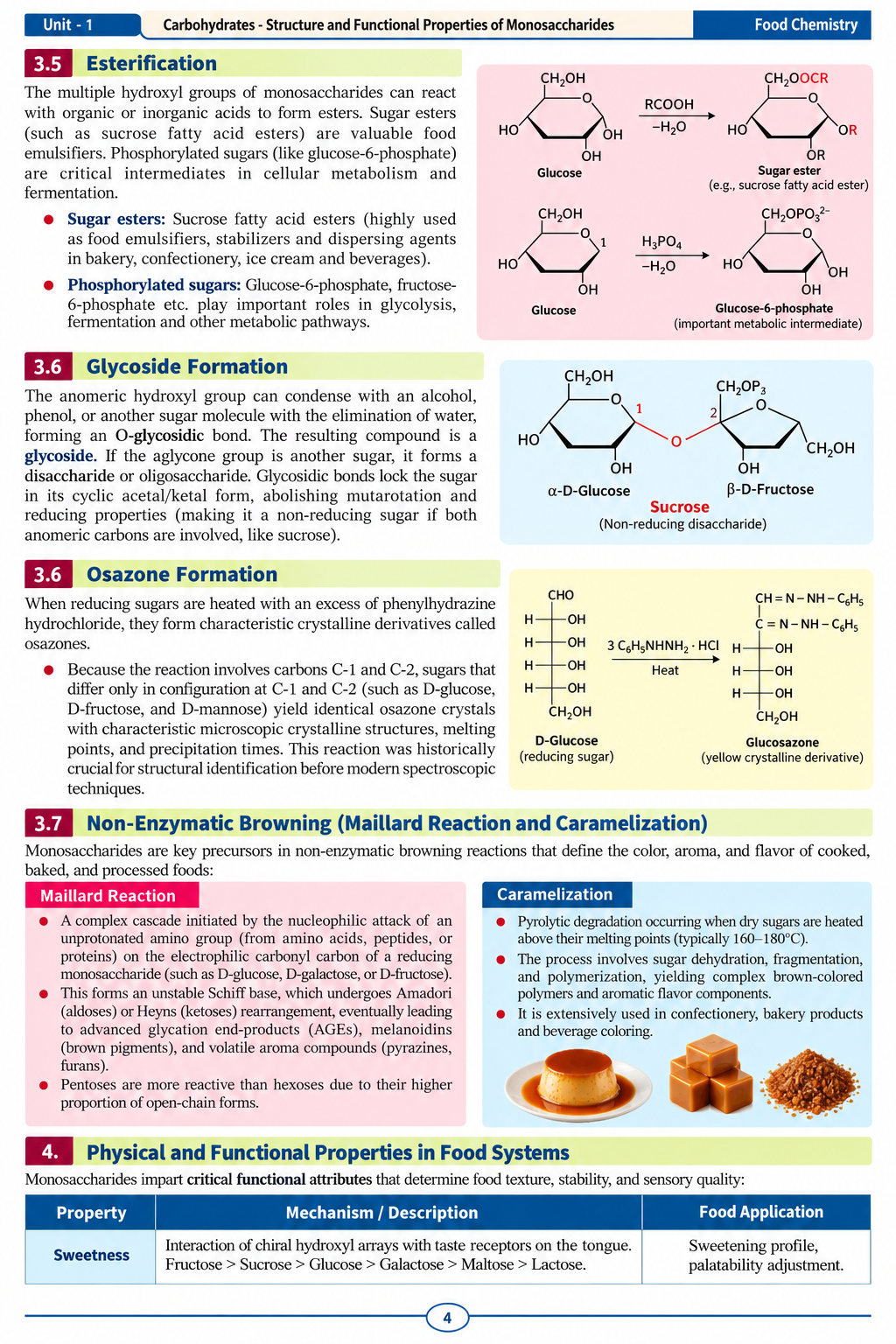
Carbohydrates - Structure and funcƟonal properƟes of mono
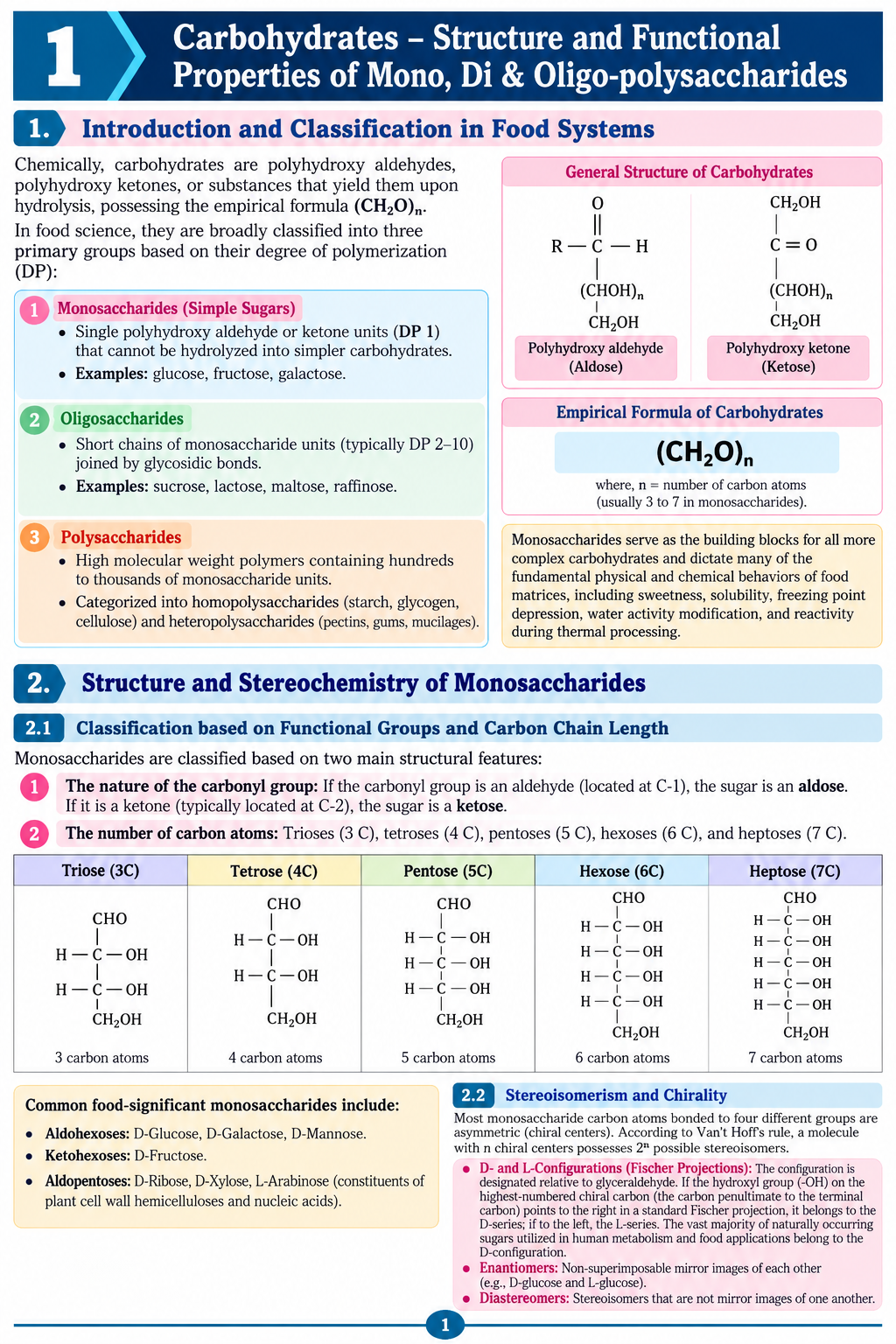
Q1. Which of the following is the simplest aldose sugar?
A. Dihydroxyacetone
B. Glyceraldehyde
C. Erythrose
D. Ribose
Answer: B. Glyceraldehyde
Explanation: Glyceraldehyde is an aldotriose (containing three carbon atoms and an aldehyde group) and represents the simplest aldose sugar. Dihydroxyacetone is the simplest ketose sugar.
Q2. In carbohydrate chemistry, ketoses can be distinguished from aldoses using which of the following reagents?
A. Fehling’s solution
B. Tollens' reagent
C. Seliwanoff’s test
D. Benedict’s test
Answer: C. Seliwanoff’s test
Explanation: Seliwanoff’s test uses resorcinol and concentrated HCl to distinguish between aldoses and ketoses. Ketoses dehydrate more rapidly than aldoses to form furfural derivatives, yielding a cherry-red complex.
Q3. Which monosaccharide is commonly known as "dextrose" in the food industry?
A. D-Fructose
B. D-Galactose
C. D-Glucose
D. D-Mannose
Answer: C. D-Glucose
Explanation: D-Glucose is optically active and rotates plane-polarized light to the right (dextrorotatory), hence it is commercially and industrially referred to as dextrose.
Q4. Fructose is a ketohexose. Its sweet taste and high solubility make it prominent in honey and fruits. What is its structural ring form in aqueous solution?
A. Pyranose only
B. Furanose only
C. An equilibrium mixture of pyranose and furanose forms
D. Open-chain linear form exclusively
Answer: C. An equilibrium mixture of pyranose and furanose forms
Explanation: In aqueous solution, D-fructose exists as an
equilibrium mixture containing both 5-membered furanose rings (predominantly  -D-fructofuranose) and 6-membered pyranose rings (-D-fructopyranose).
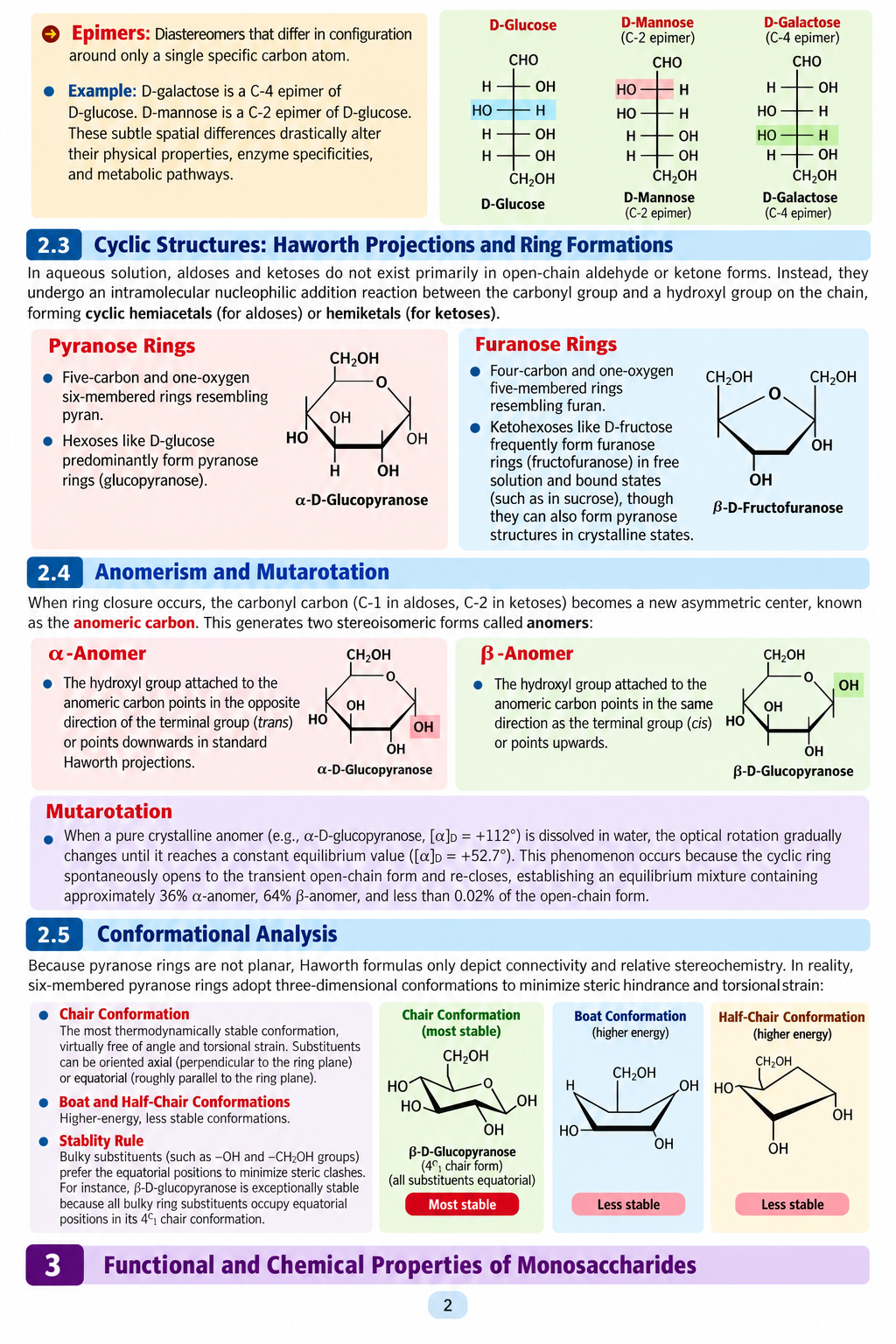
Q5. Which of the following pairs represents C-2 epimers of each other?
A. D-Glucose and D-Galactose
B. D-Glucose and D-Mannose
C. D-Glucose and D-Fructose
D. D-Ribose and D-Deoxyribose
Answer: B. D-Glucose and D-Mannose
Explanation: Epimers are diastereomers that differ in configuration around only one specific carbon atom. D-Glucose and D-Mannose differ exclusively at the C-2 position. (D-Glucose and D-Galactose are C-4 epimers).
Q6. What type of linkage or ring structure is formed when an intramolecular hemiacetal is created in an aldohexose?
A. Furanose ring (5-membered)
B. Pyranose ring (6-membered)
C. Oxirane ring
D. Pyrrole ring
Answer: B. Pyranose ring (6-membered)
Explanation: Reaction between the C-1 aldehyde group and the C-5 hydroxyl group of an aldohexose creates a stable 6-membered cyclic hemiacetal ring structure known as a pyranose ring, resembling pyran.
Q7. Which monosaccharide is a C-4 epimer of D-glucose?
A. D-Mannose
B. D-Fructose
C. D-Galactose
D. L-Fucose
Answer: C. D-Galactose
Explanation: D-Galactose differs from D-glucose solely in the spatial orientation of the hydroxyl group at the C-4 carbon atom, making it a C-4 epimer.
Q8. Which pentose sugar is an essential structural component of nucleic acids (DNA)?
A. D-Ribose
B. 2-Deoxy-D-ribose
C. D-Xylose
D. D-Arabinose
Answer: B. 2-Deoxy-D-ribose
Explanation: DNA contains 2-deoxy-D-ribose, which lacks an oxygen atom at the C-2 position compared to D-ribose found in RNA.
Q9. The conversion
of  -D-glucose and
 -D-glucose in solution leading to a change in optical rotation is known
as:
A. Racemization
B. Mutarotation
C. Inversion
D. Caramelization
Answer: B. Mutarotation
Explanation: Mutarotation is the spontaneous change in the
specific optical rotation of a freshly prepared aqueous sugar solution as it
establishes equilibrium between its  and anomeric forms.
Q10. Anomers differ in configuration specifically around which carbon atom?
A. C-1 in aldoses, C-2 in ketoses
B. C-2 in aldoses, C-1 in ketoses
C. The terminal carbon
D. The penultimate carbon
Answer: A. C-1 in aldoses, C-2 in ketoses
Explanation: The anomeric carbon is the former carbonyl carbon that becomes a chiral center upon ring closure—C-1 in aldoses (e.g., glucose) and C-2 in 2-ketoses (e.g., fructose).
Q11. The designation of D- or L-configuration for a monosaccharide is determined by the stereochemistry at:
A. The anomeric carbon
B. The highest numbered chiral carbon (penultimate carbon)
C. Carbon-2
D. The terminal primary alcohol carbon
Answer: B. The highest numbered chiral carbon (penultimate carbon)
Explanation: By Fischer convention, if the hydroxyl group on the penultimate carbon points to the right, it is a D-sugar; if it points to the left, it is an L-sugar.
Q12. Enantiomers are stereoisomers that are:
A. Superimposable mirror images
B. Non-superimposable mirror images
C. Non-mirror image stereoisomers
D. Epimers differing at two carbons
Answer: B. Non-superimposable mirror images
Explanation: Enantiomers are pairs of stereoisomers that are non-superimposable mirror images of each other, possessing identical physical properties except for the direction they rotate plane-polarized light.
Q13. The number of stereoisomers for an aldopentose with distinct chiral centers is:
A. 4
B. 8
C. 16
D. 32
Answer: B. 8
Explanation: According to van 't Hoff's rule, the maximum
number of optical isomers is  , where
 is the number of asymmetric
(chiral) carbon atoms. An aldopentose has 3 chiral centers, so
 .
Q14. Which form of D-glucopyranose is more thermodynamically stable and predominates at equilibrium in aqueous solution?
A. -D-glucopyranose (~36%)
B. -D-glucopyranose (~64%)
C. Open-chain aldehyde form (~50%)
D. -D-glucofuranose
Answer: B. -D-glucopyranose (~64%)
Explanation: -D-glucopyranose is the most stable conformer because all its bulky
hydroxyl groups occupy equatorial positions in the chair conformation,
minimizing steric hindrance.
Q15. In the stable
chair conformation of -D-glucopyranose, how many substituent groups are in equatorial
positions?
A. None
B. Two
C. Four
D. All of them (five substituents on ring carbons)
Answer: D. All of them (five substituents on ring carbons)
Explanation: In the standard chair conformation of -D-glucopyranose, all ring substituents ( groups and the
 group) are situated in equatorial
positions, which maximizes stability.
Q16. Which of the following monosaccharides is optically inactive due to a lack of chiral centers?
A. Glyceraldehyde
B. Dihydroxyacetone
C. Erythrose
D. Ribulose
Answer: B. Dihydroxyacetone
Explanation: Dihydroxyacetone lacks asymmetric carbon atoms (chiral centers), making it optically inactive and achiral.
Q17. Diastereomers that are not mirror images of each other include which of the following?
A. D-Glucose and L-Glucose
B. -D-Glucose and -D-Glucose
C. Epimers and Anomers
D. Both B and C
Answer: D. Both B and C
Explanation: Diastereomers are non-superimposable, non-mirror image stereoisomers. Both anomers and epimers fall under this classification.
Q18. What is the
specific optical rotation value of pure freshly dissolved -D-glucose that undergoes mutarotation to reach an equilibrium value of  ?
A. 
B. 
C. 
D. 
Answer: A.
Explanation: Freshly prepared -D-glucose has a specific rotation of , which gradually drops to  at equilibrium as it converts
into an equilibrium mixture with the form ().
Q19. Haworth projections are useful in food chemistry because they clearly depict:
A. The exact bond angles of tetrahedral carbons
B. The planar ring perspective of cyclic monosaccharides with substituents above/below the ring
C. The chair-boat conformations of sugars
D. Molecular weight distribution
Answer: B. The planar ring perspective of cyclic monosaccharides with substituents above/below the ring
Explanation: Haworth projections represent cyclic sugars as flat planar rings viewed edge-on, allowing easy visualization of whether functional groups are projected above or below the plane.
Q20. Which term describes sugars that have a free or potentially free carbonyl group capable of reducing oxidizing agents like Cu(II)?
A. Non-reducing sugars
B. Reducing sugars
C. Polysaccharides
D. Sugar alcohols
Answer: B. Reducing sugars
Explanation: Reducing sugars possess a free aldehyde or
ketone group (or hemiacetal/hemiketal group) that can reduce metallic ions like
 in Fehling's or Benedict's tests.
Q21. The Maillard reaction in food processing involves condensation between reducing sugars and which other food component?
A. Minerals
B. Free amino acids or proteins (amino groups)
C. Triacylglycerols
D. Organic acids
Answer: B. Free amino acids or proteins (amino groups)
Explanation: The Maillard reaction is a non-enzymatic browning reaction occurring between the carbonyl group of a reducing sugar and the free amino group of amino acids, peptides, or proteins, producing complex flavors and brown pigments.
Q22. Which monosaccharide is the most reactive in the initial steps of the Maillard reaction due to its high proportion of the open-chain form?
A. Glucose
B. Galactose
C. Fructose
D. Mannose
Answer: C. Fructose
Explanation: Fructose exists in open-chain and furanose forms to a greater extent than aldoses in solution, making it react faster in early Maillard browning reactions (especially under acidic conditions).
Q23. Caramelization is a thermal degradation process of sugars that occurs in the absence of:
A. Heat
B. Amino compounds
C. Water
D. Oxygen
Answer: B. Amino compounds
Explanation: Caramelization is the pyrolysis (thermal decomposition) of pure carbohydrates subjected to high temperatures in the absence of amino compounds, distinguishing it from the Maillard reaction.
Q24. In alkaline solutions, aldoses and ketoses can interconvert into each other through an enediol intermediate. What is this reaction called?
A. Cannizzaro reaction
B. Lobry de Bruyn-Alberda van Ekenstein transformation
C. Strecker degradation
D. Kiliani-Fischer synthesis
Answer: B. Lobry de Bruyn-Alberda van Ekenstein transformation
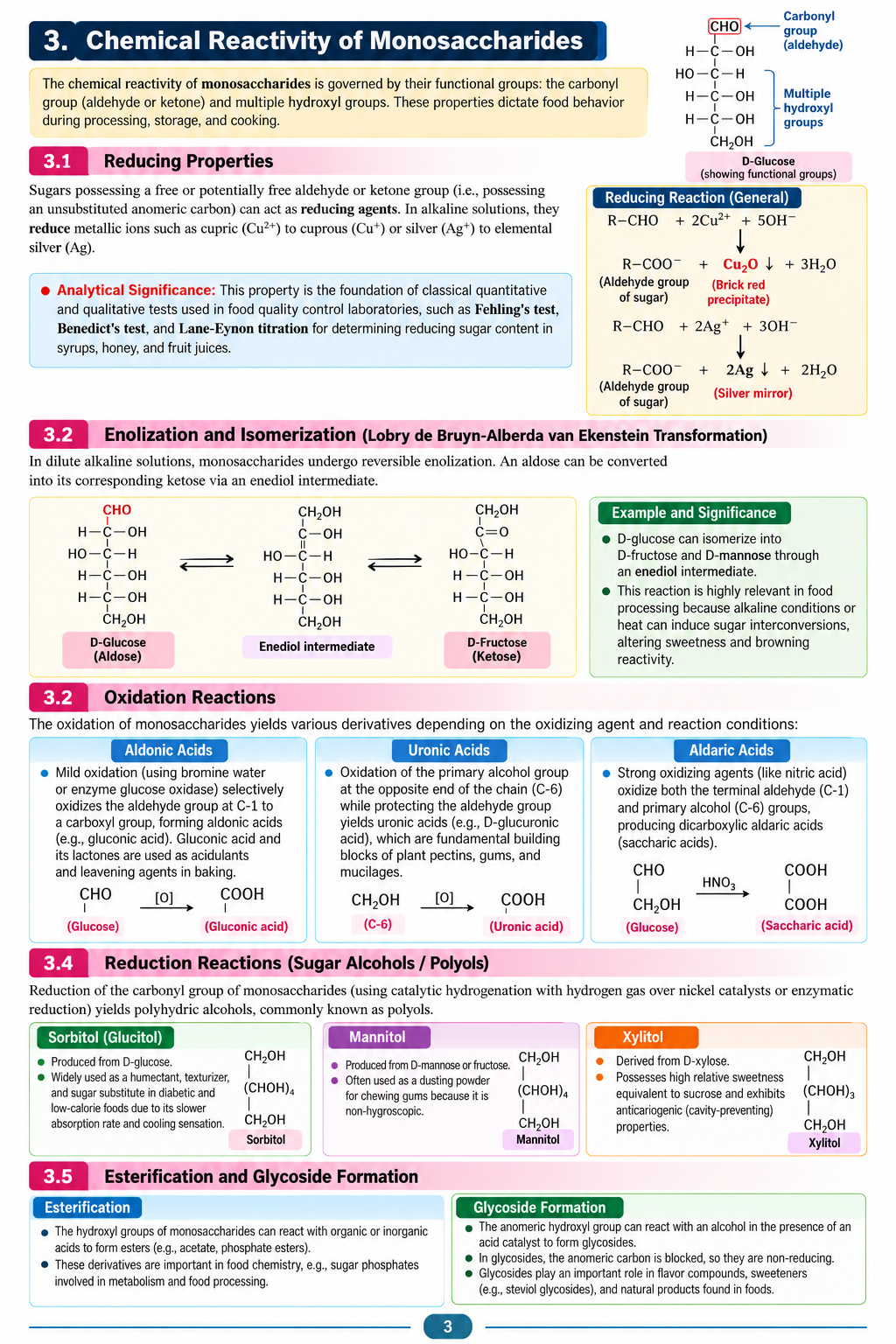
Explanation: This transformation is the base-catalyzed isomerization of monosaccharides (e.g., conversion of glucose into fructose and mannose via an enediol intermediate).
Q25. Reduction of D-glucose using catalytic hydrogenation yields which sugar alcohol (polyol), widely used as a humectant and sweetener in foods?
A. Xylitol
B. Sorbitol (Glucitol)
C. Mannitol
D. Glycerol
Answer: B. Sorbitol (Glucitol)
Explanation: Hydrogenation of the aldehyde group of D-glucose reduces it to a primary alcohol group, yielding sorbitol (also known as D-glucitol).
Q26. Mild oxidation of an aldose using bromine water selectively oxidizes the aldehyde group to form which compound?
A. Aldaric acid
B. Uronic acid
C. Aldonic acid
D. Ketoacid
Answer: C. Aldonic acid
Explanation: Bromine water is a mild oxidizing agent that specifically oxidizes the C-1 aldehyde group of an aldose to a carboxylic acid group, producing an aldonic acid (e.g., gluconic acid).
Q27. Oxidation of both terminal ends of an aldose (C-1 aldehyde and C-6 primary alcohol) with strong nitric acid produces:
A. Aldonic acid
B. Uronic acid
C. Aldaric acid (Saccharic acid)
D. Ascorbic acid
Answer: C. Aldaric acid (Saccharic acid)
Explanation: Strong oxidizing agents like nitric acid oxidize both the C-1 and C-6 groups of an aldohexose into carboxyl groups, resulting in dicarboxylic acids called aldaric acids.
Q28. Which of the following describes the sweetness index ranking relative to sucrose (set at 1.0)?
A. Fructose > Sucrose > Glucose > Galactose
B. Glucose > Fructose > Sucrose > Lactose
C. Sucrose > Fructose > Glucose > Galactose
D. Galactose > Glucose > Fructose > Sucrose
Answer: A. Fructose > Sucrose > Glucose > Galactose
Explanation: Fructose is the sweetest common monosaccharide (approx. 1.2–1.8 times sweeter than sucrose), followed by sucrose (1.0), glucose (0.7), and galactose (0.3).
Q29. What happens
to monosaccharides when exposed to concentrated mineral acids (e.g.,  ) at high temperatures?
A. They undergo polymerization into starch
B. They dehydrate to form furfural or hydroxymethylfurfural (HMF)
C. They turn into sugar alcohols
D. They undergo complete reduction
Answer: B. They dehydrate to form furfural or hydroxymethylfurfural (HMF)
Explanation: Treatment of pentoses with hot mineral acids yields furfural, while hexoses dehydrate to form 5-hydroxymethylfurfural (HMF), a key indicator of thermal damage in heat-processed foods.
Q30. Which monosaccharide serves as the precursor for the industrial synthesis of Vitamin C (L-ascorbic acid)?
A. D-Glucose
B. D-Galactose
C. D-Fructose
D. D-Mannose
Answer: A. D-Glucose
Explanation: L-ascorbic acid is industrially produced via the Reichstein process or modern fermentation methods starting from D-glucose.
Q31. Sugar derivatives where the hydroxyl group on a monosaccharide is replaced by a hydrogen atom are called:
A. Amino sugars
B. Deoxy sugars
C. Uronic acids
D. Glycosides
Answer: B. Deoxy sugars
Explanation: Deoxy sugars have one or more hydroxyl groups replaced by hydrogens (e.g., 2-deoxy-D-ribose or L-fucose/6-deoxy-L-galactose).
Q32. Glucosamine and galactosamine found in structural food components (like chitin or chitosan derivatives) are examples of:
A. Sugar alcohols
B. Amino sugars
C. Deoxy sugars
D. Thiosugars
Answer: B. Dialog/Amino sugars
Explanation: Amino sugars contain an amino group ( ) in place of a hydroxyl group (usually at C-2).
Q33. Which test is used for the general detection of carbohydrates, where a purple ring forms at the junction of concentrated sulfuric acid and an alcoholic alpha-naphthol solution?
A. Fehling's test
B. Molisch test
C. Iodine test
D. Barfoed's test
Answer: B. Molisch test
Explanation: The Molisch test is a sensitive general
chemical test for all carbohydrates, relying on acid dehydration of sugars to
form furfural derivatives that condense with -naphthol.
Q34. Barfoed’s test is specifically utilized to distinguish between:
A. Aldoses and ketoses
B. Reducing monosaccharides and reducing disaccharides
C. D-sugars and L-sugars
D. Pentoses and hexoses
Answer: B. Reducing monosaccharides and reducing disaccharides
Explanation: Barfoed's reagent uses copper acetate in a mild acetic acid solution. Monosaccharides react rapidly (within 1-2 minutes) to form a red precipitate, whereas reducing disaccharides react much more slowly.
Q35. What is the primary reason high concentrations of monosaccharides act as effective food preservatives (e.g., in jams and jellies)?
A. They raise food pH significantly
B. They lower water
activity ( ) through strong hydrogen bonding
C. They produce active antibiotics
D. They inhibit lipid oxidation directly
Answer: B. They lower water activity () through strong hydrogen bonding
Explanation: High sugar concentrations bind free water
molecules tightly via extensive hydrogen bonding, lowering water activity () below the threshold required for microbial growth and spoilage.
Q36. Hygroscopicity refers to a sugar's ability to absorb moisture from the surrounding air. Which monosaccharide exhibits the highest hygroscopicity, affecting the crispness of moisture-sensitive confectionery products?
A. D-Glucose
B. D-Galactose
C. D-Fructose
D. D-Mannose
Answer: C. D-Fructose
Explanation: Fructose is extremely hygroscopic due to its high affinity for water, which can cause hard candies and baked goods containing high-fructose corn syrup to become sticky or soggy upon exposure to humid air.
Q37. What is the physical state of pure dry D-fructose at room temperature?
A. Crystalline solid
B. Viscous liquid syrup
C. Amorphous glass/powder
D. Gaseous
Answer: A. Crystalline solid
Explanation: Pure D-fructose is a white crystalline solid, although it is extremely soluble in water and readily forms viscous syrups or amorphous states.
Q38. The solubility of monosaccharides in water increases dramatically with:
A. Decreasing temperature
B. Increasing temperature
C. Neutralization of pH
D. Addition of ethanol
Answer: B. Increasing temperature
Explanation: Sugar solubility is endothermic; raising the temperature increases molecular kinetic energy and disrupts intermolecular hydrogen bonding, allowing much higher concentrations of sugar to dissolve.
Q39. In confectionery manufacturing, the tendency of sugar solutions to crystallize is minimized by adding invert sugar. What is invert sugar?
A. A mixture of equal parts D-glucose and D-fructose produced by hydrolysis of sucrose
B. A polymer of fructose
C. A chemically modified starch syrup
D. L-glucose
Answer: A. A mixture of equal parts D-glucose and D-fructose produced by hydrolysis of sucrose
Explanation: Inversion of sucrose splits it into an equimolar mixture of glucose and fructose. Because fructose and glucose have different crystal structures, they interfere with each other's crystal growth, preventing graininess in fondants and syrups.
Q40. Which property of monosaccharides is heavily exploited in baking to provide yeast substrate for carbon dioxide production?
A. High molecular weight
B. Fermentability
C. Opacity
D. Insoluble nature
Answer: B. Fermentability
Explanation: Baker’s yeast (Saccharomyces cerevisiae) readily ferments hexose monosaccharides (glucose, fructose) into ethanol and carbon dioxide, causing dough to rise.
Q41. When glucose syrups are manufactured commercially by acid or enzymatic hydrolysis of starch, the degree of conversion is measured by:
A. Brix value
B. Dextrose Equivalent (DE)
C. Iodine number
D. Refractive index
Answer: B. Dextrose Equivalent (DE)
Explanation: Dextrose Equivalent (DE) is a measure of the percentage of reducing sugar calculated as D-glucose on a dry-weight basis, indicating the extent of starch breakdown.
Q42. A glucose syrup with a high DE (e.g., DE 60–70) will exhibit which of the following characteristics compared to a low DE syrup?
A. Lower sweetness and lower hygroscopicity
B. Higher sweetness, higher osmotic pressure, and lower viscosity
C. Higher gelling power and higher viscosity
D. Insoluble in cold water
Answer: B. Higher sweetness, higher osmotic pressure, and lower viscosity
Explanation: High DE syrups contain smaller molecules (more free mono- and oligosaccharides), which increases sweetness, osmotic pressure, and freezing-point depression while decreasing viscosity.
Q43. What is the primary functional role of monosaccharides in dairy products such as yogurt and cheese?
A. Lactose is fermented by lactic acid bacteria into lactic acid
B. Monosaccharides act as primary emulsifiers
C. They act as fat substitutes
D. They provide red color development
Answer: A. Lactose is fermented by lactic acid bacteria into lactic acid
Explanation: Although lactose is a disaccharide, its constituent monosaccharides (glucose and galactose) are liberated and metabolized by starter cultures (lactic acid bacteria) to produce lactic acid, lowering pH and curdling milk proteins.
Q44. The freezing point depression of food systems is directly proportional to:
A. The total weight of fat present
B. The total molar concentration of dissolved solute particles (such as monosaccharides)
C. The protein content
D. The ash content
Answer: B. The total molar concentration of dissolved solute particles (such as monosaccharides)
Explanation: Freezing point depression is a colligative property. Monosaccharides have low molecular weights, meaning a given weight yields high molar concentrations, significantly depressing the freezing point (crucial in ice cream manufacturing to control ice crystal size).
Q45. Which monosaccharide has a low glycemic index compared to glucose, making it popular in sports and diabetic nutritional formulations?
A. D-Galactose
B. D-Fructose
C. Maltose
D. D-Ribose
Answer: B. D-Fructose
Explanation: Fructose has a low glycemic index (GI ≈ 19) because it is metabolized primarily in the liver through pathways independent of immediate insulin secretion, causing a slower rise in blood glucose.
Q46. What chemical change occurs when monosaccharides are heated to excessive temperatures during food processing, leading to burnt off-flavors?
A. Hydrogenation
B. Deep pyrolysis and carbonization
C. Saponification
D. Peptide cleavage
Answer: B. Deep pyrolysis and carbonization
Explanation: Extreme heat past the normal caramelization stage breaks down sugar molecules completely into volatile compounds, carbon, and bitter-tasting degradation products.
Q47. The tendency of certain sugars (like lactose or glucose) to crystallize out of solution in condensed milk products during storage is called:
A. Syneresis
B. Sandiness or graininess
C. Gelatinization
D. Retrogradation
Answer: B. Sandiness or graininess
Explanation: "Sandiness" is a texture defect in sweetened condensed milk or ice cream caused by the precipitation and growth of coarse, large lactose or sugar crystals.
Q48. Which analytical method is standard for quantifying reducing monosaccharides based on the reduction of alkaline copper tartrate solution?
A. Kjeldahl method
B. Soxhlet extraction
C. Lane-Eynon titration method
D. Refractometry
Answer: C. Lane-Eynon titration method
Explanation: The Lane-Eynon method is a volumetric titration procedure using Fehling's solution (alkaline copper tartrate) to quantitatively determine reducing sugars in food extracts.
Q49. Why do concentrated sugar solutions exhibit high osmotic pressure that preserves food against microbial spoilage?
A. It draws water out of microbial cells via osmosis, causing plasmolysis
B. It punctures bacterial cell walls directly
C. It destroys bacterial DNA
D. It neutralizes cellular toxins
Answer: A. It draws water out of microbial cells via osmosis, causing plasmolysis
Explanation: The hypertonic environment created by high monosaccharide concentration causes water to leave microbial cells, resulting in cellular shrinkage (plasmolysis) and metabolic arrest.
Q50. When D-glucose is dissolved in water, what percentage of the molecules exist in the open-chain aldehyde form at room temperature equilibrium?
A. ~36%
B. ~64%
C. Less than 0.02%
D. ~50%
Answer: C. Less than 0.02%
Explanation: Thermodynamic equilibrium heavily favors the
cyclic pyranose forms (~99.98% combined for and anomers), leaving an extremely
small fraction (~0.02%) in the open-chain form, though this small pool drives
typical aldehyde reactions.
btsc food safety officer book paper-1 buy link-#https://www.apnitest.in/shop/btsc-food-safety-officer-paper-1-book-658 btsc food safety officer book paper-2 buy link-#https://www.apnitest.in/shop/btsc-food-safety-officer-paper-2-book-657 contact-7988161697 call/whatsaap www.apnitest.in btsc food safety officer, btsc food safety officer 2026, btsc food safety officer details, btsc food safety officer preparation, btsc food safety officer eligibility, btsc food safety officer vacancy 2026, btsc food safety officer syllabus 2026, btsc food safety officer best books, btsc food safety officer syllabus pdf, btsc food safety officer study plan, btsc food safety officer notification 2026, btsc food safety officer recruitment 2026, btsc food safety officer form kaise bhare, food safety officer